
Assemblymember Grace Lee Meets with Chinatown Leaders About Canal Street Redesign
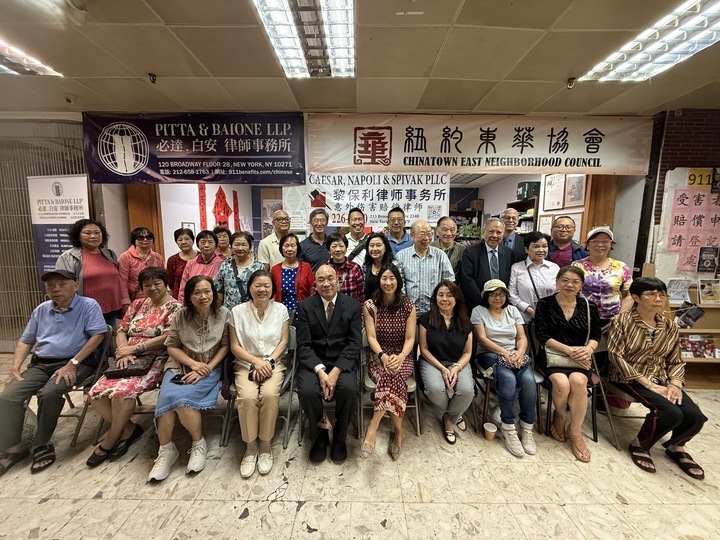
Last week, Assemblymember Grace Lee met with Chinatown community leaders to discuss the impact of the Department of Transportation's (DOT) proposed redesign of Canal Street.
The DOT Proposal includes widening the sidewalks on Canal Street by removing a lane of commercial parking. This would move commercial loading and unloading to side streets, and leave only two active traffic lanes moving in each direction on Canal Street.
Attendees included Dr. Thomas Chan, District Leaders Justin Yu and Virginia Lee, community leaders Susan Lee, Irving Lee, Edward Cuccia, Ammy Cuccia, Eleanor Wong, May Jin Zhang, Chi Loek, Sam Sang, Samantha Chan CPA, Kathy Chan, Chinese Chamber of Commerce Board Chair Tom Lo, small property owner Shing Wah Yeung, New Kam Man Market owner Hei Chan, and property owner and founder of the Chinatown Core Block Association Jan Lee.
Feedback from attendees reflected broad concern about the proposed redesign, citing potential increases in traffic due to fewer lanes and double-parking in active lanes, as well as challenges for community members with mobility issues during pick-ups and drop-offs at medical offices, and difficulties for businesses receiving deliveries along Canal Street. Assemblymember Lee agreed that the plan was not well-conceived.
“The proposed redesign of Canal Street overlooks the everyday needs and realities of our Chinatown community,” said Assemblymember Grace Lee. “Too often, decisions are made without the input of the people most affected. Chinatown’s residents and small businesses deserve to be meaningfully included in this process. I will continue to work with DOT to make sure our community is heard and its needs are addressed.”
“By eliminating commercial parking, the DOT plan will paralyze Canal Street, forcing essential delivery and medical vehicles to stop in active lanes, and making loading and unloading more difficult for businesses in the area,” said Dr. Thomas K. Chan, Co-Chair of the Greater Chinatown Civic Coalition. “Before considering sidewalk widening, the City should first explore other options, such as ensuring that sidewalks are properly managed in accordance with the CATS II Study and exploring adding central islands and installing curb extensions at crosswalks to enhance pedestrian safety. Thank you to Assemblymember Grace Lee for meeting with us and advocating for the community on this redesign"
In addition, attendees noted that the plan was introduced without sufficient community engagement. In response to a question from Jan Lee about whether the Department of Transportation had consulted local stakeholders during its development, no attendees reported being contacted.
“City studies were done here about 25 years ago and reached a clear conclusion: widening sidewalks on Canal Street would create more problems than it solves,” said Jan Lee, Founder of the Chinatown Core Block Association. “Before DOT revives an old idea, they should revisit the data with the community at the table. Thank you to Assemblymember Grace Lee for standing with our neighborhood and making sure Chinatown’s voice is heard in this process.”
“Removing all commercial parking on Canal will push delivery and medical transport into active lanes, choking the corridor to a single working lane each way,” said District Leader Justin Yu. “Before widening sidewalks, the City should create real loading zones and manage sidewalks and vending. I’m glad Assemblymember Lee is working with the community and DOT to make sure Chinatown’s concerns are heard.”
The Honorable Grace Lee Member, New York State Assembly 64 Fulton Street, Room 302 New York, NY 10038
Dear Assembly Member Lee,
DOT is proposing to widen the Canal Street sidewalks by removing the commercial parking spaces from Broadway to Elizabeth Street. Under the DOT plan, only two active traffic lanes will remain in each direction on Canal Street, and there will be no parking spaces on Canal Street. The work will start in June of next year.
As you all know, we have hundreds of restaurants and stores in Chinatown and Little Italy, as well as many medical offices on Canal Street. After removing the parking spaces on Canal Street, I am very concerned about where food and goods delivery trucks, Amazon trucks, UPS, FedEx, bank armored trucks, etc., will unload and deliver their goods. Where will ambulettes or car services drop off and pick up patients, especially those with mobility problems who rely on wheelchairs and walkers?
If these vehicles are forced to stop in active traffic lanes, Canal Street will effectively be reduced to a single working traffic lane in each direction. This will create severe congestion on Canal Street, spilling over to the Holland Tunnel, the Manhattan Bridge, and all the side streets. As a result, drivers from New Jersey and other boroughs may stop coming into Chinatown and Little Italy for food, shopping, and services.
In addition, Canal Street is one of only two fully crosstown streets in Lower Manhattan, and it is the main corridor from the Manhattan Bridge to the Holland Tunnel. Reducing Canal Street to one working traffic lane is inviting gridlock and an environmental disaster. This would severely delay emergency services, such as fire trucks and ambulances, and endanger the lives of all who live or work downtown.
DOT plans to have trucks park on the side streets to unload, but the problems are:
1. Side streets are already too congested. There is no space for trucks coming from Canal Street.
2. Delivery trucks may be too big to enter the side streets.
3. The side streets may be too far for workers to carry heavy goods for several blocks along Canal Street. Workers carrying goods along Canal Street could jam up the sidewalks.
4. It is also dangerous for patients with mobility problems who use wheelchairs or walkers to travel a long way along Canal Street to reach medical offices.
Before considering sidewalk widening, the City should first explore other options, such as ensuring sidewalks are properly managed. According to the Canal Area Transportation Study - Track II (CATS II Study) conducted in 2010, sidewalk management is critical. Without designated loading zones and vendor regulation, sidewalk widening will be ineffective. Furthermore, without strict enforcement of the required minimum 8-foot clear pedestrian path, the additional space will likely be occupied by vendors, encroachments, and loading activities rather than serving its intended purpose of improving pedestrian mobility and safety.
Illegal vending should be stopped on Canal Street. Even where street vending is legal, the minimum 8-foot clear pedestrian path must be maintained. If necessary, some vendors should be relocated to less congested areas on Canal Street.
In addition, we could add central islands and install curb extensions at crosswalks to keep pedestrians safe. Curb extensions could extend about 6–8 feet from the sidewalk at crosswalks (not along the entire length of the sidewalks) on both sides, reducing the crossing distance for pedestrians. At the same time, commercial vehicles could still park on Canal Street to unload and make deliveries.
Thomas K. Chan, MD, FACP, FCCP
Co-Chair, Greater Chinatown Civic Coalition